Composite materials have been increasingly used in manufacturing in recent times, especially in industries that seek materials combining toughness, durability, and lighter weight. When it comes to composite manufacturing, there is an extensive list of reinforcement materials available. Out of those materials, E-Glass Fiber stands out to be one of the commonly chosen reinforcement materials.
But what exactly is E-Glass Fiber, and why does it continue to be an important material for composite manufacturers?
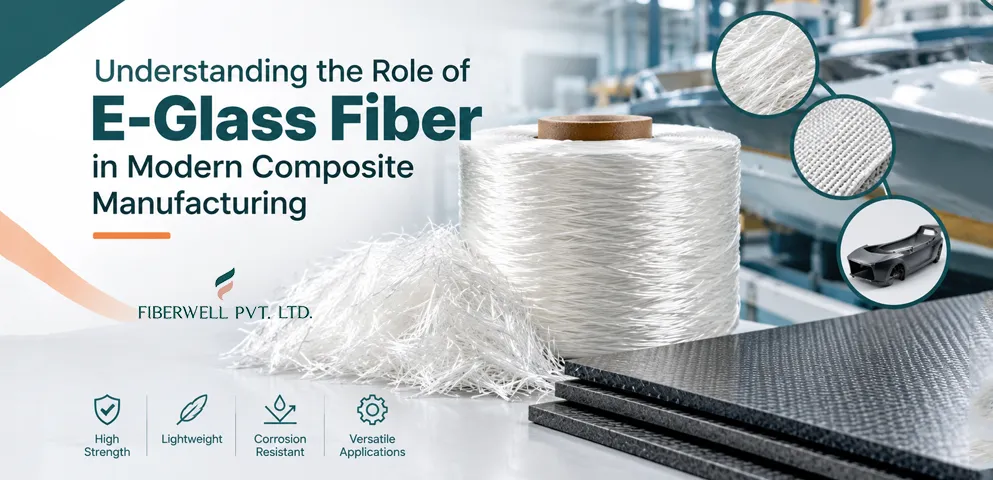
E-Glass Fiber is a type of glass fiber manufactured from glass filaments and primarily used as reinforcement in polymer-based composites. The individual filaments are extremely fine, but when combined into suitable fiber forms, they provide the reinforcement required to improve the mechanical performance of composite structures.
The "E" in E-Glass refers to electrical glass, reflecting its original development for electrical insulation applications. Over time, its use has expanded considerably into general composite manufacturing because of its strength, electrical insulation characteristics, and compatibility with commonly used resin systems.
Based on the need for production, E-Glass Fiber can be supplied in the form of chopped strand, woven roving, and continuous roving. This is because the interaction between the various forms with the resin will differ, hence enabling producers to choose an appropriate reinforcement based on the finished part design.
A major reason for the continued use of E-Glass Fiber is its compatibility with several commonly used resin systems. Polyester, vinyl ester, and epoxy resins are frequently combined with E-glass reinforcement to manufacture different types of FRP and composite products.
The interaction between the glass fiber and resin is important because the resin transfers loads between the reinforcing fibers while helping form the final shape of the component. For this reason, fiber sizing and surface treatment also matter. Proper sizing helps improve compatibility between the glass surface and the selected resin, contributing to better processing and composite performance.
There is no single E-Glass Fiber format suitable for every composite manufacturing process. The selection depends on factors such as the production method, component design, resin system, required fiber orientation, and desired mechanical properties.
For example, continuous roving may be suitable for processes where continuous reinforcement is required, while chopped strands can be incorporated into compounds or used in processes where shorter reinforcement is preferred. Woven roving provides a structured arrangement of fibers and can be used where reinforcement in specific directions is required.
This makes understanding the manufacturing process just as important as understanding the fiber itself.
E-Glass Fiber is sometimes confused with Alkali Resistant (AR) Glass Fiber, but the two are designed for different environments.
E-glass is commonly used with polymer and resin systems for composite manufacturing. AR glass fiber, in comparison, is specifically developed to withstand the alkaline conditions associated with cement-based materials and is commonly considered for applications such as glass fiber reinforced concrete.
Choosing between these materials therefore depends on the matrix in which the fiber will be incorporated and the environment in which the finished product will operate.
In composite manufacturing, fiber quality can influence processing as well as the final product. Consistent filament characteristics, suitable sizing, controlled manufacturing, and reliable supply are important considerations when sourcing E-Glass Fiber.
For manufacturers, selecting a supplier that understands both the material and its intended processing requirements can make the sourcing process more effective. The right specification should be selected according to the resin, manufacturing technique, component design, and expected service conditions.
As composite materials continue to find their place across industrial and engineering sectors, reinforcement selection remains an important part of product development. E-Glass Fiber offers a practical and established reinforcement solution for manufacturers working with polymer-based composite systems.
For businesses looking for dependable E-Glass Fiber Manufacturer in India, Fiberwell India provides glass fiber solutions designed around different composite manufacturing requirements. Choosing the appropriate fiber form and specification can help manufacturers maintain consistency from material selection through to finished composite production.
E-Glass Fiber is primarily used as reinforcement in polymer-based composites and FRP manufacturing.
Yes. E-glass is commonly compatible with epoxy, polyester, and vinyl ester resin systems.
Common forms include chopped strands, woven roving, and continuous roving.
Standard E-glass is generally intended for polymer-based composites. AR Glass Fiber is more appropriate for cement-based applications requiring alkali resistance.