Most people outside manufacturing have never thought about monofilament fiber. Engineers who've had a filtration mesh fail mid-production, or an agricultural net degrade two seasons early, think about it constantly.
The material is simple by design: one continuous strand of extruded synthetic polymer. That structure is what making it reliable acrossvarious demanding applications.
Multifilament yarn twists or braids many fine fibers together. Monofilament is one unbroken thread smooth surface, consistent diameter, predictable behaviour under load.
The polymer choice matters more than most buyers expect. Polypropylene (PP) absorbs almost no moisture and tolerant chemical exposure well. Polyester (PET) handles high-temperature and high-load environments better. Nylon (PA) adds elasticity and abrasion tolerance. Polyethylene (PE) works where stiffness and low weight both matter. Pick the wrong polymer for your application and the product will tell you.
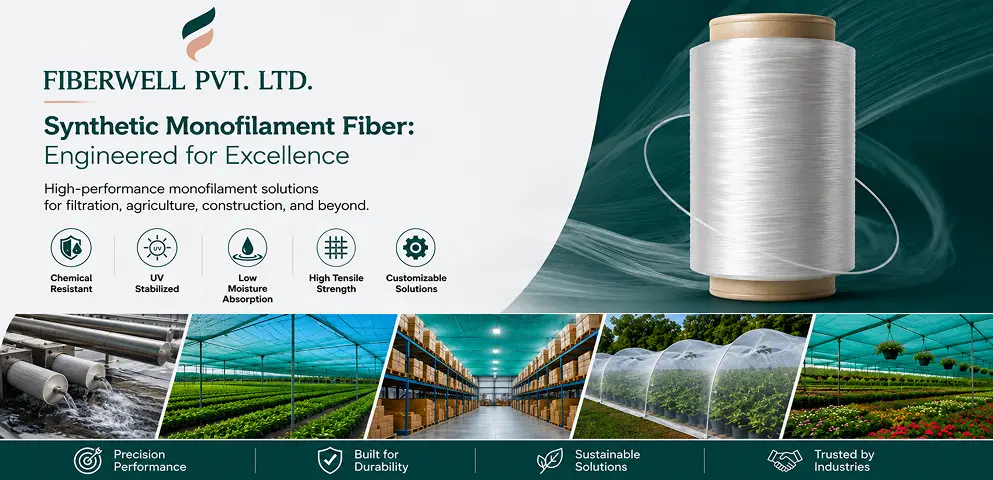
Industrial filtration is one of the largest application areas. Woven monofilament fabrics form precision filter mesh for liquid and air filtration across food processing, pharmaceuticals, water treatment, and chemical plants. The smooth strand surface cleans faster and resists particle clogging in ways multifilament fabrics simply can't match.
Agriculture Sector depends heavily on UV-stabilized monofilament for shade nets, crop support nets, and anti-insect screens. Single-strand construction resists dirt retention and doesn't absorb moisture, so nets stay light after rain. A small detail until you've seen a crop support structure collapse mid-season.
Construction and civil engineering use monofilament-based geotextile fabrics for drainage, erosion control, and soil separation. The controlled pore size passes water while holding soil in place. That math only works if the monofilament diameter and weave are consistent throughout.
Aquaculture, fishing, and sports netting of tennis, badminton, squash rely on monofilament for stiffness and abrasion resistance under constant stress. Papermaking and conveyor mechanism use monofilament forming fabrics that require dimensional stability and resistance to heat and chemicals across thousands of working hours.
Diameter consistency is not at all negotiable for filtration. Because it's a single extruded strand, diameter control is tight and pore size in a finished woven mesh directly on it.
Low moisture absorption keeps PP and PE monofilaments stable in wet environments. Chemical resistance varies by polymer but covers acids, alkalis, and organic solvents for most industrial uses.
Customization happens during extrusion. UV stabilizers, antistatic agents, flame retardants, and colour master batches go into the strand before its formed properties built in from the start, not applied to the surface afterward.
Diameter range, tensile strength, elongation at break, and surface finish vary across manufacturers and polymer grades. A specification error in filtration mesh affects every downstream process and supplier experience matters as much as material quality. Someone who understands your application catches a spec problem before production starts, not after a batch fails.
Monofilament consists of a single extruded polymer strand, while multifilament yarns are made using twisting or braiding processes to bring many fine fibers together.
Yes, Monofilament polypropylene with UV stabilizers is commonly used. This material gives good resistance to UV aging, low moisture absorption, and sustained strength under long - term outdoor exposure. Polyester is used when there are high tensile needs or higher temperatures.
Yes, during extrusion process UV stabilizers, antistatic, flame retardant, and colourmaster batch compounds can be added into the strand of monofilament fiber. The diameter, tensile and elongation characteristics can be also varied, depending on manufacturing capabilities. The better the application requirement is known in advance, the better the results will be achieved.
Synthetic monofilament fiber rarely fails suddenly. It degrades slowly through UV breakdown, chemical exposure, or diameter drift that shifts filtration performance over months. That's why material selection and supplier reliability matter far more than most buyers initially expect.
For manufacturers and engineers sourcing synthetic monofilament fiber for industrial, agricultural, or technical textile applications, Fiberwellindia.com offers a range of monofilament fiber products across polymer types and specifications. Our team can work through your application requirements before production begins.